bosun lighting
Member Center
Exit
Data is empty
0


  • Home
  • |
  • LED Street Light
  • |
  • Solar Street Light
      • All In One Solar Street Light
      • Separated Solar Street Light
      • Solar Flood Light
      • Solar Garden Light
      • AC/DC Solar Street Light
      • Hybrid Solar Street Light
      • MPPT Solar Charge Controller
      • Ultra-Low Temperature Battery
  • |
  • Smart Street Light
      • Smart LED Street Light
        • 4G/LTE Solution
        • LoRa-MESH Solution
        • PLC Solution
        • RS485 Solution
      • Smart Solar Street Light
        • Solar 4G / LTE Solution
        • Solar LoRa-MESH Solution
      • Smart Street Light Controller
        • CONCENTRATOR
        • GATEWAY
        • NEMA IOT & ZHAGA IOT
  • |
  • Smart Pole
      • Smart Pole 01
      • Modularity Smart Pole 15
      • Solar Smart Pole 01
      • Smart Pole 13
      • Smart Pole 14
      • Whimsical Smart Pole
  • |
  • About Us
      • All Products
      • Projects
      • Technology
      • Free DIALux Design
      • R&D Team & Pro-Laboratory
      • Patent Certifications
      • Exhibition
        • 2025-04 Hong Kong
        • 2025-04 Saudi Arabia
        • 2025-06 Guang Zhou
        • 2025-10 Hong Kong
      • Resource
        • BOSUN Info
        • News
        • Specification Brochure Download
        • Blog
        • Video
        • F.A.Q
        • Warranty Policy
  • |
  • Contact Us
      • Privacy Policy
  • |
  • Urban Lighting Design
      • India One-Stop Solar Solution
image English
  • image English
  • image Español
HomeBOSUN InfoBLOG
Feasibility of LED Photovoltaic Lighting System in Municipal Construction

Feasibility of LED Photovoltaic Lighting System in Municipal Construction

author: Aurora
2025-08-07


Priority Choice for Municipal Street Lighting - Commercial Solar Street Lights

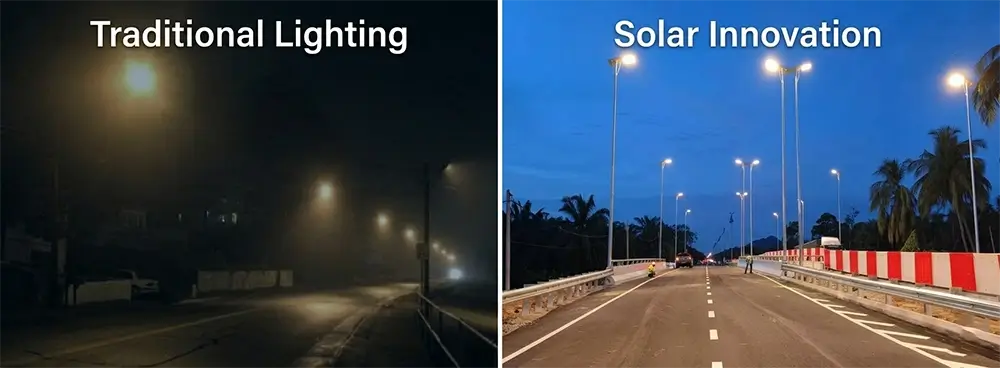
In the field of municipal engineering, the use of traditional street lights is not only a high cost of input, but also the shortcomings of high energy consumption and high operating costs in the later operation process. With the development of technology, LED light source has been gradually into the civil and industrial fields, with directional light, low power consumption, good driving characteristics, fast response speed and long service life and other advantages. In addition, the LED light source also has a DC drive, which has the advantage of low voltage, making the use of solar photovoltaic power generation, battery - LED lights an independent power supply lighting system has become possible. At present, high-pressure sodium lamps powered by utility electricity are still used as lighting tools on urban roads.

Comparative Analysis with the Traditional Lighting System  

     1

Comparative analysis of traditional high-pressure sodium lamps and LED photovoltaic lighting systems can be found: 

   11
The theoretical life of the high-pressure sodium lamps light source 20,000 h, due to the impact of power grid voltage fluctuations and high starting current, the actual life of only 5,000-6,000 h, lamps and lanterns fail randomly and need to rent elevated trucks to replace the lamps and lanterns, which leads to high maintenance costs, and the LED photovoltaic lighting system except the battery other components can reach 10 years or more, using maintenance-free gel battery.

    1

In an LED photovoltaic lighting system, except for the battery, the life of other components can reach more than 10 years, the use of a maintenance-free gel battery, with battery life ranging from 3 to 5 years to 6 to 8 years, maintenance costs are relatively low.
How to Design the Perfect Light Solution & Key Factors to Consider

  • Assess Lighting Requirements
Identify illumination levels (lux) required for the road or area type.
Define pole height, spacing, and beam distribution.
Match LED wattage to meet photometric needs while maintaining efficiency.
  • Photovoltaic System Design
PV Module Sizing: Calculate daily energy demand and match it to local solar irradiation data to determine the required PV panel wattage.
Battery Sizing: Select capacity based on daily load, desired autonomy days, depth of discharge, and efficiency factors.
Controller Selection: Choose MPPT controllers for higher efficiency and intelligent dimming functions.
  • Optimize Solar–Battery Combination
Balance PV power and battery storage to avoid oversizing while ensuring year-round reliability.
Use high-quality lithium or gel batteries for longer life and reduced maintenance.
  • Choose the Right Fixture & Components
Use commercial photovoltaic systems with high-efficiency LEDs, low-glare optics, and weather-resistant housing.
Ensure components meet IP65+ and anti-corrosion standards for municipal use.
  • Installation Planning
Optimize tilt angle and orientation for maximum solar exposure.
Ensure pole foundations and wiring (if hybrid) meet safety and durability standards.

Key Factors to Consider in Feasibility Analysis within Municipal Project

  1. Solar Resource Availability – Use local meteorological data to estimate daily peak sun hours.
  2. Load Profile – Accurate estimation of LED wattage, working hours, and dimming schedules.
  3. Autonomy Requirement – Number of days the system should run without sunlight (typically 3–7 days for municipal projects).
  4. System Voltage – Higher voltages (e.g., 24V, 48V) reduce current and cable losses.
  5. Climate Conditions – Temperature extremes, humidity, dust, and wind load.
  6. Maintenance Access – Ease of battery replacement, cleaning, and diagnostics.
  7. Project Budget & Life-Cycle Cost – Consider total cost of ownership, not just the installation cost.
  8. Compliance & Standards – Adhere to municipal lighting codes, safety regulations, and sustainability goals.

Example Regional Solar Energy Resources Survey and Analysis 

For example of a region belonging to the solar energy resource-rich areas, the isolation rate 56%, the year-round solar projection angle is large, the annual solar radiation indicators for 5,016 ~ 5,852 (MJ/m2), the annual number of days of sunshine 2,200 ~ 3,000 h, the day of standard light equivalent time of 4.26 h / d, belongs to the development of photovoltaic power generation is very suitable for the development and utilization of the city.

Analysis and Calculation of Illumination and Power 

"Urban Road Lighting Design Standard" gives the standard value of motor vehicle road lighting on branch roads as well as the light distribution type of cut-off type lamps and luminaires, the arrangement of and the installation height of lamps and luminaires, the relationship between the spacing, it gives the LED lamps for road lighting should pay attention to the relevant issues.
Level Road Rype Road Brightness Road Illumination
Glare Limit Threshold
Increment Maximum Initial Value Ti(%)
Environment Ratio
Average Brightness
Maintenance Value
The Overall Uniformity
is the Smallest
Longitudinal Uniformity Average Illuminance Maintenance Value Minimum Uniformity - -
III Branch Road 0.510.75 0.4 - 8/10 0.3 15 -

 
Under this illuminance condition, the simulation results meet the requirements of the road lighting index. If we continue to increase the luminous flux, the index will be further improved, so take the luminous flux of about 4,000 lm of 40 W LED lamps, which can meet the design standard requirements.

Municipal Solar Street Light Battery Capacity Calculation 

Optimization of Solar Module and Battery Capacity Combination The goal of is to reduce the project cost by using the minimum number of solar modules and the capacity of the battery under the premise of guaranteeing the reliability of power supply to the loads of the LED street lamps to ensure that the LED lighting system can be operated economically by means of the most optimized design. Analysis shows that the lighting power is 40 W. Setting the system voltage level to 24 V, the lighting system is illuminated for about 9 h per day on average, and the total power consumption is 360 W-h per day. The results show that the required battery capacity of 24 V, 141.18 A-h can be realized by using two 12 V, 150 A-h colloidal batteries in series.

PV Module Power Selection 

The PV fixed tilt angle in this area is best at 25°, according to the literature statistics, the total annual solar radiation of the tilted surface at 25° to the south is 6,004.0 MJ/m2, then the average daily radiation equivalent of PV modules installed at 25° to the south is 4.57 h/d. Calculations show that the power of the PV module is 225.1 W. The demand can be met by connecting two 24 V 120 W solar panels in parallel.
The feasibility of an LED photovoltaic lighting system in municipal construction depends on precise photovoltaic system design, optimized sizing of commercial solar street lights, and careful consideration of environmental and operational factors. By integrating high-efficiency components, data-driven sizing, and smart controls, municipalities can achieve long-term reliability, lower costs, and a greener urban environment.
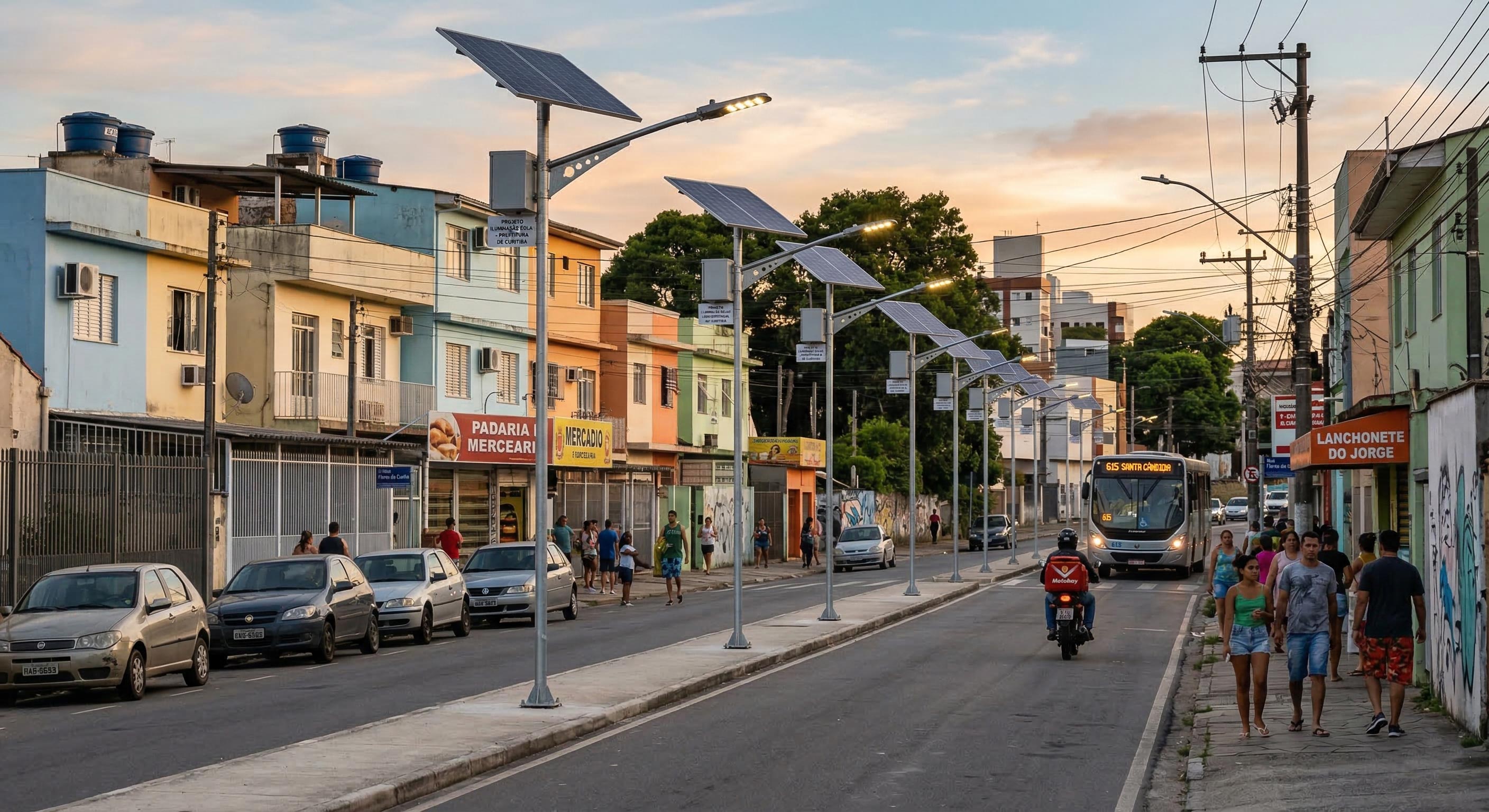
The construction of solar street lights do not need to build lighting box-type substation, construction of pipelines, laying cables, set up lighting monitoring boxes and maintenance wells and other ancillary facilities, while the traditional utility street lamps necessary for the work large amount of work, long cycle and construction costs are huge, far beyond the street lamps itself procurement costs, but also seriously affect the use of the road, in contrast to the construction of the solar street lamps appear to be especially simple convenient and cost-saving. The construction of solar streetlights is much simpler and more cost-effective than the construction of traditional streetlights.
In terms of operation, solar street lights do not need to consume utility power, wireless road energy loss, with lower maintenance costs, greatly saving the operation and maintenance costs, to achieve the purpose of energy saving and environmental protection. Contact us for your exclusive lighting design.

Hot-Selling Municipal-Use Solar Street Light

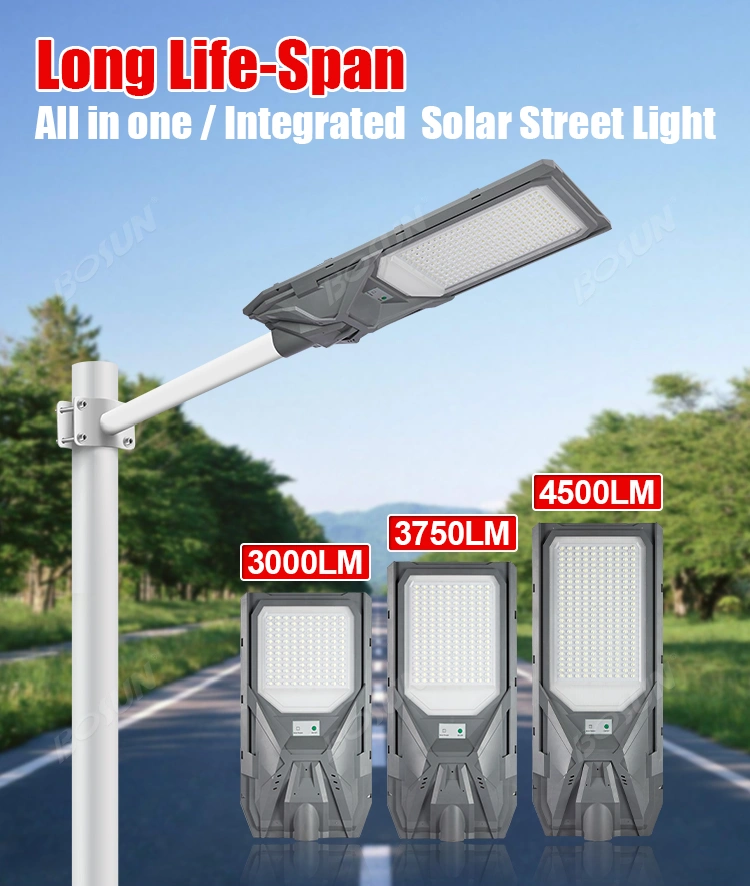
High Lumen Road Lighting All in One Solar Street Light | 3000–4500LM
Advanced Solar Street Light Features for Modern Urban Lighting
All Products
Warranty Policy
Oem & Odm 150W Long Life-span Integrated Solar Street Light - BS-QBD-SMART Series

Related News

  • image Smart Street Light Deployment for Transportation Infrastructure in Indonesia
    2026-04-13 0
  • image What Is a NEMA Controller?
    2026-03-31 0
  • image Best Solar Street Light Manufacturer? Start With These Questions
    2026-03-19 0
  • image Full-Scope Solar Street Lighting Packages & Custom Solutions for Municipalities & Developers
    2025-11-26 0
  • image Cloud-Synergy Smart Street Light Surveillance System for Smart City Development
    2025-11-17 0
  • image How Do Solar Lights Work?
    2025-10-24 0
  • image Clarification about Solar Wind Turbine Street Light: Preferred Choice for Remote Area Lighting & Wind Power System
    2025-10-16 0
  • image The Most Intelligible Instruction about Intelligent Solar Street Light​ & Engineering Project Showcase
    2025-09-26 0
  • image Integrated solar street lights promote urban lighting progress
    2025-08-18 0
  • image What is the Life Expectancy of the Solar Panel, LED Fixture, and LiFePO4 Batteries?
    2025-08-12 0
  • image Roadway Lighting Solutions | JH Series for Municipal Projects
    2025-07-30 0
  • image How to Design & Realize LoRa-MESH IoT Solar Street Light City Project?
    2025-07-19 0
  • image How to Design the Perfect Well-Considered Smart Light Pole City Road Lighting Solution?
    2025-07-16 0
  • image Design and Application of All-in-One Solar Street Light with MPPT Charge Controller
    2025-06-26 0
  • image The Ultimate Guide to City Street Light Poles and Smart LED Lighting
    2025-06-04 0
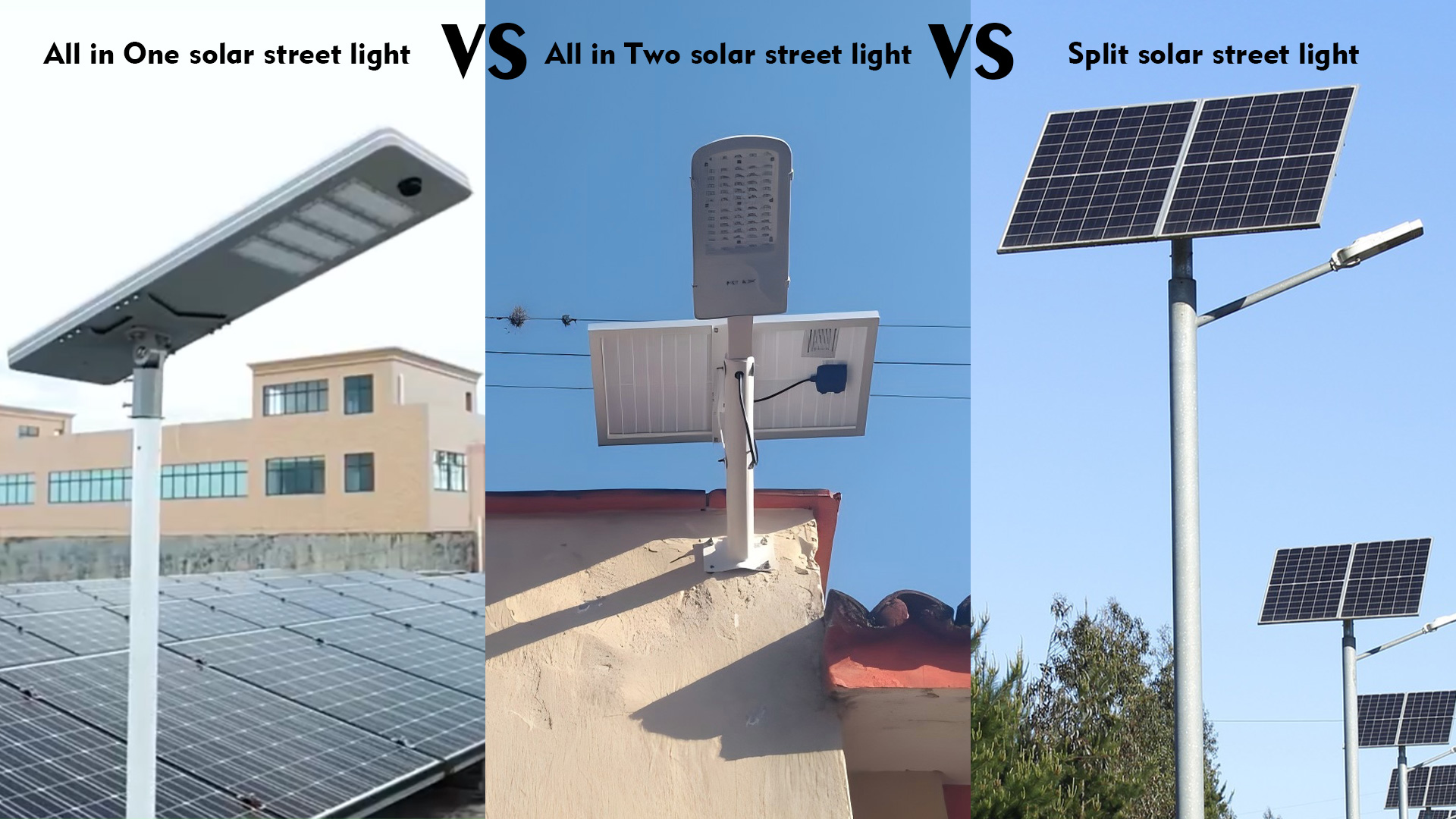
  • image Understanding the Differences Between All-in-One, All-in-Two, and Split Solar LED Street Lights
    2025-05-20 0
  • image Applications and Fundamentals of Lithium Batteries in Solar Street Lights​
    2025-05-13 0
  • image Smart Pole Accessory Modules for Middle East Smart Cities

    2025-04-26 0
  • image Hybrid Solar Street Lighting: Renewable Energy Pros and Cons of Solar, Wind, and the Future
    2025-04-08 0
  • image Solar Flood Lights Transforming Sports Facilities
    2025-03-24 0

-

Bosun Lighting company address
Bosun Lighting contact number
bosun lighting email address

PHONE & WHATSAPP

+86 186-7602-4888

EMAIL

bosun3@bosunlighting.com

SHARE

Floor 4-5, Building 2, Tongyi Qifang Industrial Area,Guzhen Town, Zhongshan City, China

©2019-2026 zcy All rights reserved.

粤ICP备12019139号 粤公网安备44030502001115号

bosun lighting

RESOURCE

VIDEO

WARRANTY POLICY

Free DIALux Design

Professional laboratory

BLOG

F.A.Q

ABOUT US

PROJECTS

NEWS

TECHNOLOGY

PRODUCT

LED STREET LIGHT

SOLAR STREET LIGHT

SMART STREET LIGHT

SMART CITY

CONTACT US

FACEBOOK

LINKEDIN

INSTAGRAM

TWITTER

YOUTUBE

QUORA

ADDRESS

PINTEREST

(341396)