
How to Design & Realize LoRa-MESH IoT Solar Street Light City Project?
author: Aurora
2025-07-19







LoRa-MESH IoT Solar Street Light is Trending All Over the World
With the rise of smart cities and the continuous advancement of intelligent technologies, IoT smart street lighting has become a powerful tool in reshaping how urban spaces are managed and illuminated. One of the most promising innovations is the LoRa-MESH IoT lighting system, especially when combined with solar-powered street lights, creating a highly efficient, sustainable, and scalable outdoor lighting solution. Internet of Things-based solar control system breaks the traditional street light control system, which can only perform switching control and can not realize the positioning, control, and real-time monitoring of a single lamp. The Internet of Things applications, including the field of energy use, will be more and more important.
Overall Design of the IoT Smart Lighting System & Functions
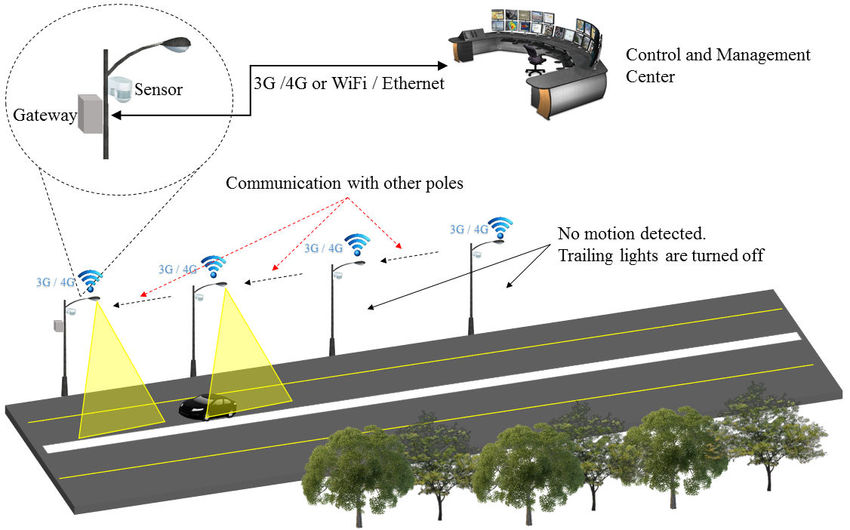
Long Range Radio (LoRa)-based IoT solar-powered smart street light system (hereinafter referred to as “IoT street light control system”) consists of a solar street light terminal, a data collector, and a cloud server. The terminal communicates with the concentrator through the LoRa module, and the concentrator communicates with the server through the 4G module. Its main functions are as follows.
(1) The terminal device mainly collects and reads the operation parameters of the solar LED street light and transmits the processed data to the corresponding concentrator via the LoRa module.
(2) The concentrator is responsible for forwarding the commands from the server to the terminal devices or obtaining the data transmitted by the terminal devices and transmitting them to the backend of the control system through the wireless communication protocol.
(3) The server first verifies the concentrator number and terminal device number, and then parses the received data and realizes the monitoring of the urban outdoor lighting system through the user interface (UI) of the computer (PC) browser.
Why IoT and Solar Are the Future of Street Lighting
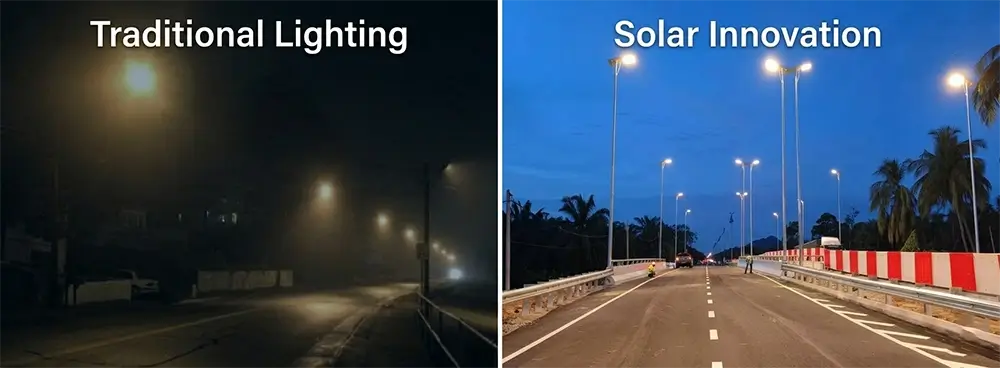
Traditional street light systems often rely on manual operation or basic timers, lacking the flexibility and efficiency required by modern cities. The IoT smart lighting system addresses this limitation by introducing features like:
- Real-time remote monitoring and control
- Individual lamp status tracking
- GPS-based location and diagnostics
- Smart green energy usage and predictive maintenance
Under “Data Monitoring”, there are functions of “Data Statistics”, “Charge/Discharge Data Statistics” and “Global Distribution of Terminals”. Under “Data Monitoring”, there are “Data Statistics”, “Charging and Discharging Data Statistics” and “Global Distribution of Terminals” functions, which can provide data statistics on the number of projects, concentrators and terminals, charge/discharge quantities in the last 7 days, one month and one year, and the global distribution of the number of terminals.
The “GPS location” function can locate any terminal for user management and maintenance.
Under “Terminal Control”, there are “Parameter Configuration”, “Parameter Summary” and “Alarm Summary”. “Parameter Configuration” can refresh, remotely control, real-time parameter acquisition and parameter setting of the terminal, query and update the information of all the terminals, and set the working mode of the terminal according to different environments; “Parameter Summary” can summarize the working status, data information of all the terminals. “Parameter Summary” can display the working status and data information of all terminals; “Alarm Summary” shows the status and data information of problematic terminals.
Users can view the historical charging and discharging data of each solar LED street light through the “Historical Report” for operation and maintenance.
When paired with solar LED street light setups, the system becomes entirely self-sustained, using renewable energy while maintaining full connectivity and control.
What is a LoRa-MESH IoT Smart Lighting and Why It's Ideal?
A LoRa-MESH network is a long-range, low-power wireless communication protocol designed for IoT devices. In the context of IoT lighting control, LoRa-MESH creates a self-forming, self-healing network among street lights, enabling each node (lamp) to communicate with others and relay data back to a central gateway.
Key advantages include:
Key advantages include:
Wide coverage: Ideal for large urban or rural deployments.
Low energy consumption: Matches the low-power design of solar-powered street lights.
Stable communication: Even if one node fails, the mesh reroutes the data automatically.
Scalability: Easily expand the system by adding new lights without redoing the infrastructure.
Steps to Design the Best IoT LoRa-MESH Solar LED Street Light System
Site Planning & Solar Evaluation
Analyze the location's sunlight exposure, traffic density, and lighting needs. Choose the right solar LED street light models for each area, balancing battery size, solar panel efficiency, and LED output.
Analyze the location's sunlight exposure, traffic density, and lighting needs. Choose the right solar LED street light models for each area, balancing battery size, solar panel efficiency, and LED output.
LoRa-MESH Topology Design
Plan how the solar-powered street lights will connect to the gateways. Ensure signal strength, data relay reliability, and redundancy to avoid communication blackouts.
Plan how the solar-powered street lights will connect to the gateways. Ensure signal strength, data relay reliability, and redundancy to avoid communication blackouts.
IoT Lighting Control Integration
Use a smart street lighting system or cloud dashboard to control brightness schedules, gather energy data, monitor lamp status, and receive alerts. This transforms your lights into a smart, manageable network.
Use a smart street lighting system or cloud dashboard to control brightness schedules, gather energy data, monitor lamp status, and receive alerts. This transforms your lights into a smart, manageable network.
Smart Street Lighting System Installation & Configuration
Install solar-powered street light poles, mount the solar units, and configure LoRa communication modules. Each lamp should automatically join the LoRa-MESH network and be visible in the control platform.
Install solar-powered street light poles, mount the solar units, and configure LoRa communication modules. Each lamp should automatically join the LoRa-MESH network and be visible in the control platform.
Testing & Optimization
Run diagnostics to ensure smooth operation, proper signal handshakes, and stable solar charging. Adjust lighting profiles according to use case: security, road lighting, or park ambiance.
Run diagnostics to ensure smooth operation, proper signal handshakes, and stable solar charging. Adjust lighting profiles according to use case: security, road lighting, or park ambiance.
Integrating IoT smart lighting with solar-powered street lights and LoRa mesh communication is a game-changer for future-ready cities. The system brings the benefits of renewable energy, intelligent automation, and real-time insight into a single network. From reducing energy costs to improving urban safety and management efficiency, the best solar street lights today are smart, connected, and solar-powered.
By designing a well-planned IoT lighting system based on LoRa-MESH, you don't just light up the streets—you illuminate the future.
By designing a well-planned IoT lighting system based on LoRa-MESH, you don't just light up the streets—you illuminate the future.
Hot-Cake IoT Smart Lighting Devices


IoT Smart Lighting System
 Smart Street Light Deployment for Transportation Infrastructure in Indonesia
  What Is a NEMA Controller?
  Best Solar Street Light Manufacturer? Start With These Questions
  Full-Scope Solar Street Lighting Packages & Custom Solutions for Municipalities & Developers
  Cloud-Synergy Smart Street Light Surveillance System for Smart City Development
  How Do Solar Lights Work?
  Clarification about Solar Wind Turbine Street Light: Preferred Choice for Remote Area Lighting & Wind Power System
  The Most Intelligible Instruction about Intelligent Solar Street Light & Engineering Project Showcase
  Integrated solar street lights promote urban lighting progress
  What is the Life Expectancy of the Solar Panel, LED Fixture, and LiFePO4 Batteries?
  Feasibility of LED Photovoltaic Lighting System in Municipal Construction
  Roadway Lighting Solutions | JH Series for Municipal Projects
  How to Design the Perfect Well-Considered Smart Light Pole City Road Lighting Solution?
  Design and Application of All-in-One Solar Street Light with MPPT Charge Controller
  The Ultimate Guide to City Street Light Poles and Smart LED Lighting
  Understanding the Differences Between All-in-One, All-in-Two, and Split Solar LED Street Lights
  Applications and Fundamentals of Lithium Batteries in Solar Street Lights
  Smart Pole Accessory Modules for Middle East Smart Cities
  Hybrid Solar Street Lighting: Renewable Energy Pros and Cons of Solar, Wind, and the Future
  Solar Flood Lights Transforming Sports Facilities